In recent years, the market size of handheld ultrasound devices has been expanding gradually. A variety of portable handheld ultrasound machines have emerged on the market, yet there are few comparative studies targeting different handheld ultrasound machines. Based on literature research, this paper compares and analyzes 7 common handheld ultrasound devices available on the market, providing professional and practical procurement references for ultrasound equipment buyers.
The five most ideal characteristics of handheld ultrasound machines are image quality, ease of use, portability, probe size, and battery life. Among them, image quality and ease of use are the two core indicators affecting the performance of the equipment.
This paper will first introduce these six products, and then conduct an in-depth evaluation of the following 6 mainstream best handheld ultrasound machines from the two key dimensions of image quality and ease of use: Butterfly iQ+™, Clarius™, Kosmos™, TE Air™, Vscan Air™ SL & CL, Lumify™.
1. 6 best handheld ultrasound machines
1.1 Butterfly iQ+™
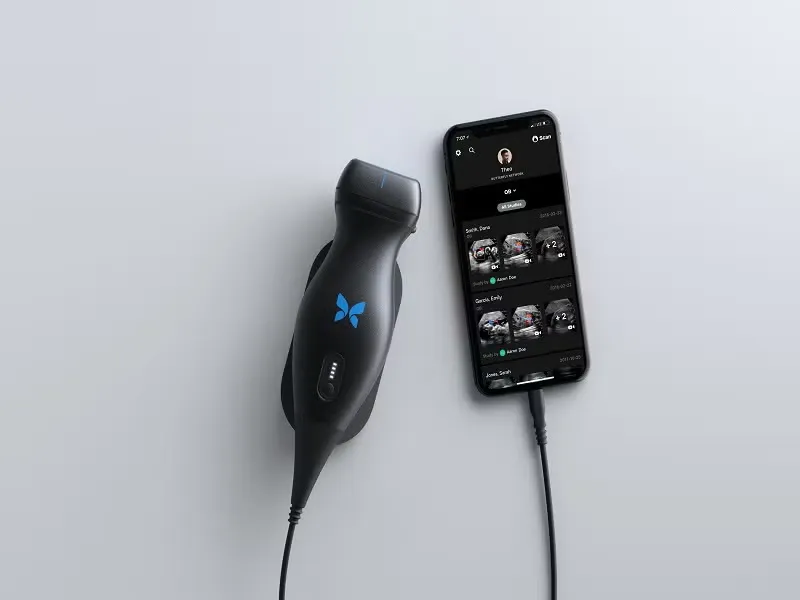
• Background: Developed by Butterfly Network of the United States, Butterfly iQ+ is its second-generation single-probe full-body handheld ultrasound machine, officially launched in 2020.
• Core technology: Second-generation Ultrasound-on-Chip, integrating approximately 9,000 CMUTs (Capacitive Micromachined Ultrasonic Transducers) with on-chip digital microwave beamforming; supporting 5 imaging modes including B/M/color Doppler/power Doppler/pulsed Doppler, with one-click switching of 20+ anatomical presets.
• Form and connection: Palm-sized handheld probe, connected to iOS/Android mobile phones/tablets via replaceable durable cables.
• Performance and pricing: Frame rate increased by 15%, pulse repetition frequency increased by 60%; battery life increased by 20% compared with the first generation; priced at about 2,700 US dollars, with Core/Advanced software subscriptions (annual fees of 300/420 US dollars); fully charged in about 5 hours.
• Advantages: Covers full-body scenarios such as heart, lung, abdomen, blood vessels, and musculoskeletal without replacing probes, greatly simplifying equipment management and reducing procurement costs; small size, rugged, waterproof and dustproof.
• Disadvantages: Compared with high-end cart-based ultrasounds, the imaging resolution/penetration of deep parts, obese patients, and fine cardiac structures (such as valves) is weak; overheating protection may occur during long-term scanning, affecting continuous operations; must be used with mobile phones/tablets; the probe contact surface is relatively fixed, and the operation in some narrow anatomical areas is not as flexible as special small probes.
1.2 Clarius™
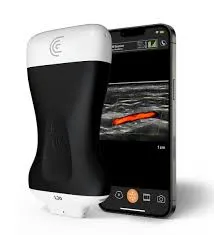
• Background: Clarius™ is a benchmark wireless high-definition, AI-driven handheld ultrasound device, featuring imaging quality comparable to mid-range cart-based machines and full-scenario wireless POCUS, achieving an excellent balance among portability, professionalism, and ease of use.
• Core technology: Wireless connection, WiFi Direct (no network required), compatible with iOS 14+/Android 11+, no cable constraints; 192-element high-performance piezoelectric crystals (non-CMUT) with Xilinx SoC, processing power 8 times that of ordinary handheld ultrasound machines, ensuring deep penetration and high resolution.
• Imaging modes: B/M/color Doppler/power Doppler/pulsed Doppler/elastography/needle enhancement.
• Pricing model: Hardware: about $$3,595 (taking C3 HD3 as an example); Software: annual subscription system (about$$595/year), unlocking advanced AI, remote control, measurement and continuous updates.
• Advantages: Cable-free, direct connection to mobile phones, multi-probe covers full-body clinical needs from superficial (20MHz) to deep (40cm), more suitable for specialized precise diagnosis than single-probe solutions; deep penetration (up to 40cm), high resolution, close to mid-range cart-based ultrasounds in abdomen, heart, musculoskeletal and other scenarios.
• Disadvantages: A single probe cannot cover the whole body, and the multi-probe procurement cost plus annual subscription makes the long-term ownership cost higher than single-chip single-probe solutions (such as Butterfly iQ+); temporary delay or disconnection may occur in complex electromagnetic environments (such as operating rooms), which has a certain impact on real-time interventional operations.
1.3 Kosmos™
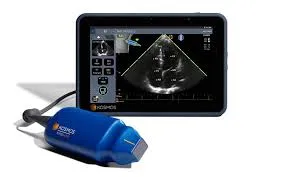
• Background: Kosmos™ is an AI-driven, cart-level imaging, single-probe full-body coverage high-end POCUS handheld ultrasound device launched by EchoNous, focusing on core scenarios of heart/abdomen/lung, realizing rare CW/TDI full Doppler and deep AI automation in handheld devices.
• Probe technology: Single-phase array PZT probe, covering 1–5MHz, supporting full-body scenarios such as heart, abdomen, lung, and blood vessels.
• Protection and battery life: IPX7 waterproof and dustproof, drop-resistant; single battery supports 90 minutes of continuous scanning, and can be charged while scanning with Kosmos Link (up to 8 hours).
• Warranty: Industry-leading 5-year whole-machine warranty.
• Imaging modes: B/M/color Doppler/power Doppler/PW/CW/TDI full-spectrum Doppler (rare in handheld ultrasound devices).
• Pricing: Probe + Bridge: about $$8,000–10,000; Kosmos Plus (including iPad + stand + full set of software): less than$$21,000.
• Advantages: PZT+ASIC architecture, complete CW/TDI/color Doppler, heart/abdomen/lung imaging quality close to mid-range cart-based ultrasounds, one of the most complete Doppler products in handheld ultrasound devices; phased array narrow-face design, easy to access intercostal windows, complete heart, abdomen, lung, blood vessel and other examinations without replacing probes, greatly simplifying the process; IPX7, drop-resistant, 5-year warranty.
• Disadvantages: High price, single set system about $$8,000+, higher than Butterfly iQ+ $$2,700) and Clarius ($3,600), high entry threshold; total weight of probe + Bridge is nearly 900g, and wired connection is not as flexible as pure wireless handheld ultrasound devices (such as Clarius); upper limit of phased array probe frequency is low (5MHz), resolution in musculoskeletal, skin, superficial blood vessels and other scenarios is not as good as linear array probes, requiring additional purchase of linear array probes (higher cost); must be used with Bridge or tablet, screen size and battery life are limited by external devices.
1.4 TE Air™
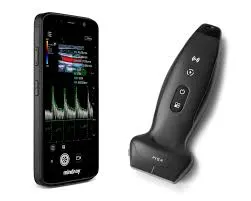
• Background: TE Air™ is a wireless dual-mode, single-crystal technology, cart-level imaging high-end POCUS handheld ultrasound machine launched by Mindray Medical, focusing on full-body coverage + professional-level Doppler + high durability, a benchmark product of domestic handheld ultrasound devices.
• Dual-mode design: Independent use (connected to mobile phones/tablets) + as a wireless probe for Mindray TE X cart-based ultrasound, one machine for two purposes.
• Probe technology: i3P (phased array), e5M (convex/linear array).
• Body specifications: Ultra-light weight (about 200–250g), magnesium alloy body, IP68 dustproof and waterproof (fully immersible for disinfection), drop-resistant.
• Battery life and charging: Single battery: 60 minutes of continuous scanning, fast charging: 35 minutes to 90%.
• Connection: WiFi Direct direct connection to iOS/Android, no network dependence; supports DICOM and hospital information system docking.
• Imaging modes: B/M/color Doppler/power Doppler/PW/TDI tissue Doppler (i3P), e5M supports elastography.
• Pricing: i3P (heart/abdomen main): about $$4,500–5,500; e5M (full-body all-rounder): about$$5,500–6,500; Air Capsule: about $500; software functions: no annual subscription, all AI and advanced functions are built-in.
• Advantages: Can be used as an independent handheld ultrasound machine or a wireless probe for TE X cart, one machine equals two; high resolution, deep penetration, strong Doppler performance, leading in heart TDI, abdomen, lung imaging quality among Chinese handheld ultrasound devices; multi-probe covers the whole body, IP68, immersible disinfection, drop-resistant; AI is free built-in, no subscription cost, long-term ownership cost is much lower than subscription-based competitors such as Clarius.
• Disadvantages: i3P phased array probe (5MHz upper limit) has average resolution in musculoskeletal, skin, superficial blood vessels and other scenarios, needing to match e5M linear array probe, increasing procurement cost; compared with international brands such as Clarius and Butterfly, it still has a gap in clinical recognition and installation volume in the high-end European and American markets.
1.5 Vscan Air™
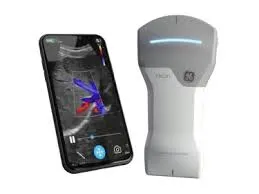
• Background: Vscan Air™ is a wireless dual-probe, pocket-sized, full-body coverage classic POCUS handheld ultrasound machine launched by GE HealthCare, focusing on extreme portability + dual-probe all-rounder + military-grade durability, one of the global benchmark products of high-end handheld ultrasound devices.
• Dual-probe design: 2-in-1 convex array + linear array, full-body scanning without replacing probes.
• Body specifications: Only 205g, size 131×64×31 mm, can be put into a white coat pocket; IP67 waterproof and dustproof, supports MIL-810G military-grade drop resistance, high-temperature and high-pressure disinfection.
• Battery life and charging: Single battery 50 minutes of continuous scanning; 75 minutes to 90%; supports Qi wireless charging.
• Connection: WiFi Direct direct connection to iOS/Android mobile phones/tablets, no network dependence; supports DICOM and hospital information system docking.
• Imaging modes: B/M/color Doppler/pulsed Doppler (PW); equipped with harmonic imaging to improve signal-to-noise ratio, reduce artifacts, and enhance tissue clarity.
• Pricing: Vscan Air CL (convex array + linear array) about $$6,000–7,000, Vscan Air SL (phased array + linear array, heart-optimized) about$$7,000–$8,000.
• Advantages: 2-in-1 convex array + linear array, full-body coverage with a single device, no need to carry multiple probes; IP67, drop-resistant, high-temperature disinfection; high image signal-to-noise ratio, few artifacts, abdomen, lung, blood vessel imaging quality is in the first echelon of handheld ultrasound devices, high clinical recognition.
•Disadvantages: Relatively high price, high entry barrier; only supports PW pulsed Doppler, lacks CW continuous Doppler and TDI tissue Doppler, making its ability for detailed cardiac assessment (such as valvular blood flow and cardiac function) weaker than competitors like Kosmos and TE Air i3P; single battery only lasts 50 minutes, requiring frequent charging or a spare battery for heavy use.
1.6 Lumify™
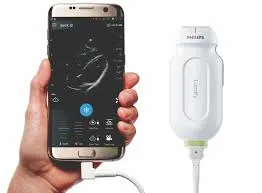
• Background: Lumify™ is a probe-as-ultrasound, USB direct connection, ultra-long battery life, military-grade durable high-end POCUS handheld ultrasound machine launched by Philips Healthcare, focusing on extreme portability + full-scenario coverage + no subscription cost, one of the global benchmark products of handheld ultrasound devices.
• Probe-as-ultrasound design: No host, no built-in battery, only the probe itself, connected to iOS/Android mobile phones/tablets via USB-C, plug and play.
• Three professional probes: S4-1 (phased array), C5-2 (convex array), L12-4 (linear array).
• Body specifications: Single probe only 150–200g, ultra-light portable; military-grade durability (4-foot drop test), IPX7 waterproof, supports various disinfection methods.
• Battery life and power supply: No built-in battery, completely powered by mobile devices; a single mobile phone can support 7.5 hours of continuous scanning, completely solving the battery life pain point of handheld ultrasound machines.
• Connection: USB-C direct connection, zero delay, no network dependence; supports DICOM, PACS, EMR system docking.
• Imaging modes: B/M/color Doppler/power Doppler/PW pulsed Doppler; equipped with SonoCT, xRes, tissue harmonic imaging to improve signal-to-noise ratio and reduce artifacts.
• Pricing: S4-1 (phased array/heart) about $$6,000; C5-2 (convex array/abdomen) about$$5,500; L12-4 (linear array/superficial) about $6,000; software functions: no annual subscription, all AI and advanced functions are built-in.
• Advantages: No host, no battery, single probe only 150–200g, truly pocket-sized; powered by mobile devices, a single mobile phone can scan continuously for 7.5 hours, completely solving the battery life pain point of handheld ultrasound machines; high image resolution, deep penetration, few artifacts, heart, abdomen, lung imaging quality is in the first echelon of handheld ultrasound devices; compared with WiFi connection, USB direct connection has no delay or disconnection, more reliable for real-time interventional guidance.
•Disadvantages: Lacks a dual-probe-in-one design; separate probes (S4-1, C5-2, and L12-4) must be purchased individually for cardiac, abdominal, and superficial imaging, resulting in a high total cost for a complete set. Supports only PW (Pulsed Wave) Doppler, lacking CW (Continuous Wave) Doppler capabilities, which limits its ability to assess high-velocity cardiac blood flow. Supports only direct USB connection and does not offer a Wi-Fi wireless mode.
2. Image Quality Comparison
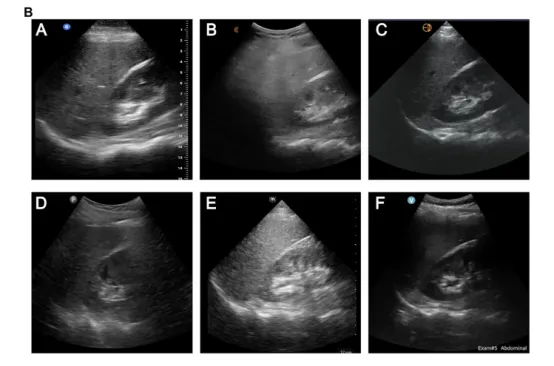
Image quality is the core indicator of handheld ultrasound devices. Poor image quality will directly affect clinical judgment, and the equipment will lose its application value if it cannot obtain clear images meeting clinical diagnostic needs.
The following figure shows the comparison of right upper abdomen images of 6 handheld ultrasound machines in an academic study: A: Butterfly iQ+™, B: Clarius™, C: Kosmos™, D: Lumify™, E: Mindray, F: Vscan Air™.
35 bedside ultrasound experts also compared the images of the 6 devices on the apical four-chamber view of the heart, neck and superficial lung views, and scored them from five dimensions: detail resolution, contrast resolution, penetration, noise interference and overall satisfaction.
The results show that:
• Highest right upper abdomen image score: Vscan Air™
• Highest apical four-chamber image score: Mindray TE Air™
• Highest neck and superficial lung image score: Lumify™
In general, Vscan Air™, Lumify™ and Mindray have the highest expert satisfaction in terms of image quality.
3. Ease of Use Comparison
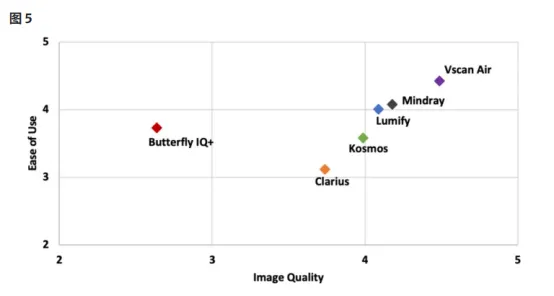
The above figure shows the average score comparison of 6 handheld ultrasound devices in image quality and ease of use by experts.
It can be seen from the chart that Vscan Air has the highest scores in both image quality and ease of use, with balanced and excellent performance; Butterfly IQ+ has average image quality but good ease of use; Mindray and Lumify perform well in both indicators; Clarius has good image quality but the lowest ease of use score.
Ease of use is another core characteristic of handheld ultrasound machines. Wireless connection is usually more popular and advantageous, but if the pairing between the device and the tablet is slow or the connection is unstable, wireless will become a shortcoming. In addition, artificial intelligence is considered to further improve the ease of use of equipment, but the actual role of AI in the medical field is still unclear, and how clinicians apply AI in point-of-care ultrasound (POCUS) remains to be explored. Adding AI functions to handheld ultrasound devices requires a key balance in probe characteristics: if AI functions significantly increase the volume, weight or cost of the probe, the attractiveness of this new technology to clinicians will be greatly reduced.
4. Overall Satisfaction Comparison
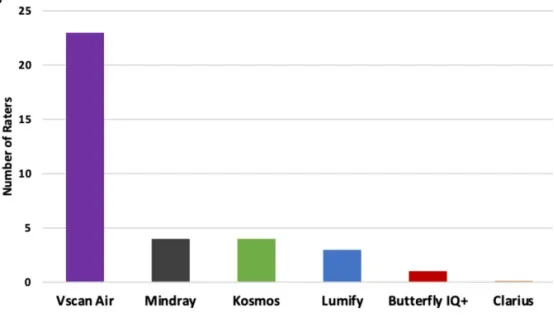
It can be seen from the figure that when asked which portable handheld ultrasound machine they would prefer to choose as a personal portable pocket device, 66% of the 35 experts chose Vscan Air™. Combined with the previous research results, this is also highly consistent with its optimal performance in both image quality and ease of use.
5. Conclusion
Based on the above analysis, among the 6 handheld ultrasound devices: Butterfly iQ+™, Clarius™, Kosmos™, TE Air™, Vscan Air, Lumify™, Vscan Air performs best in image quality and ease of use; Butterfly iQ+ has relatively poor image quality and average ease of use; Mindray ranks second in overall satisfaction; Kosmos and Lumify perform well in both image quality and ease of use; Clarius has good image quality but the lowest ease of use score.
Of course, as the gap in image quality and ease of use among handheld ultrasound machines continues to narrow, additional characteristics such as portability, probe ergonomics, battery life, imaging modes and price will become the key to distinguishing product competitiveness. In the future, these factors are likely to directly affect users' purchasing decisions. In actual clinical procurement and use, users need to comprehensively consider their own application scenarios, budgets and operating habits to select the most suitable portable handheld ultrasound machine.
6. ArKang Recommendation
Of course, in addition to the above 6 best handheld ultrasound machines, ArKang also recommends its own handheld ultrasound devices, such as AKB-C10T.
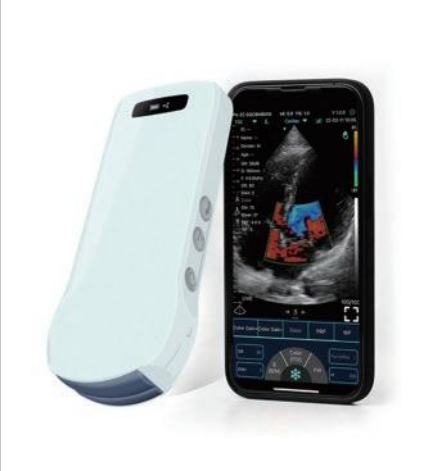
• Background: ArKang AKB-C10T adopts advanced 3-in-1 probe, integrating convex array, linear array and heart probe, a high-performance wireless handheld ultrasound device.
• Connection: Seamless connection with smartphones, tablets and PCs.
• Probe technology: Convex array: 3.5/5.0MHz (depth 90-305mm) for abdomen and deep tissue imaging; Linear: 7.5/10MHz (depth 20-80mm) for superficial structures and small parts; Heart: 2.5/5.0MHz (depth 90-160mm) for echocardiography.
• Imaging modes: B, B/M, color Doppler, pulsed wave, power Doppler imaging (PDI).
• Clinical application: Suitable for all-round measurement in various specialties.


